





Core Committee
Mathew Arthur
Capilano UniversityGregory J. Seigworth
Millersville UniversityWendy J. Truran
Northeastern UniversityEldritch Priest
Simon Fraser UniversityAnn Cvetkovich
University of Texas Austin
Society for the Study of Affect (SSA)
Methods, Atmospheres, Knowledges, Energies
Friday, October 23 to Sunday, October 25, 2026
October 23 to 25, 2026
Simon Fraser University, Vancouver Canada
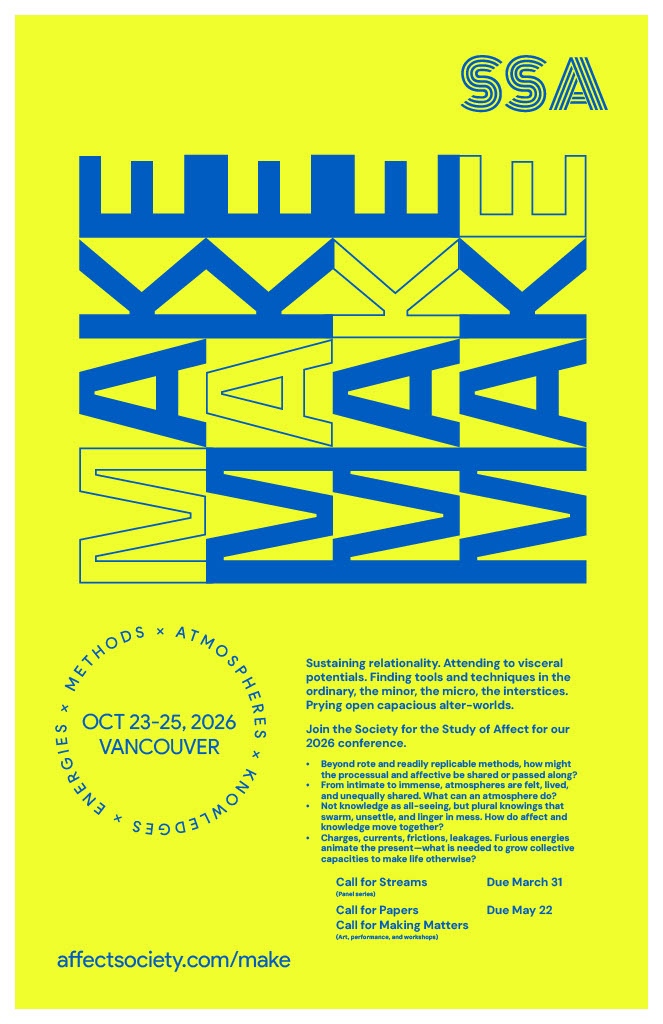
After three consecutive international affect theory conferences in downtown Lancaster Pennsylvania (#WTF 2015, #AIMS 2018, and #PITS 2024), the Society for the Study of Affect (SSA) is relocating to Vancouver for our 2026 conference MAKE: Methods, Atmospheres, Knowledges, Energies. Vancouver will provide an indelible vibe-and-scene shift for our gathering, a redistribution of the senses, and ample opportunities to discover (and recover) collective capacities to connect and persist in the face of existential-fascist challenges multiplying in ways too rapid and numerous to count.
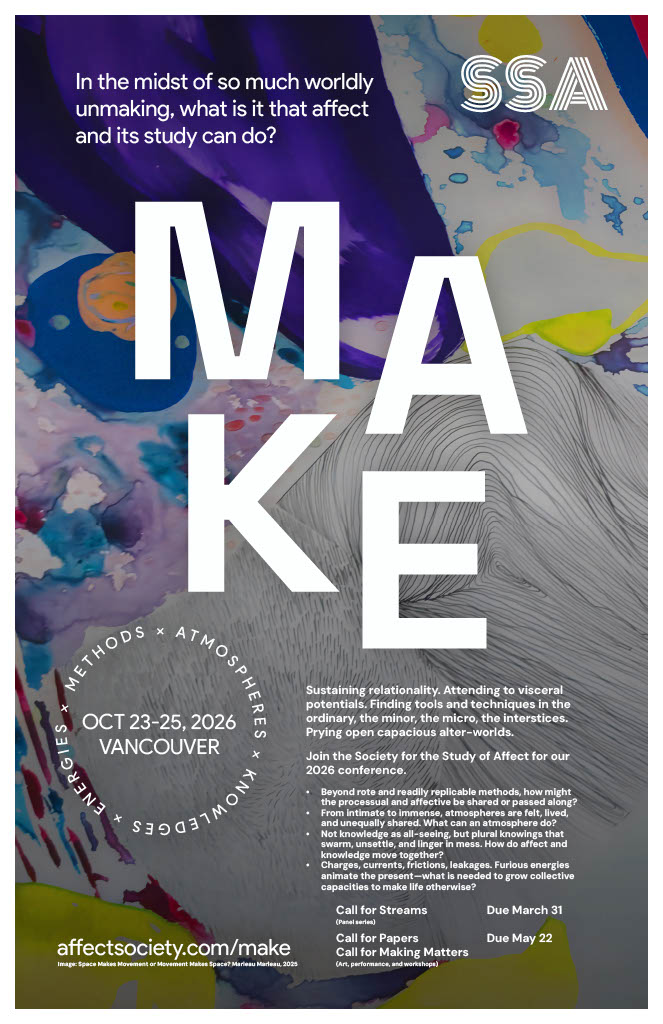
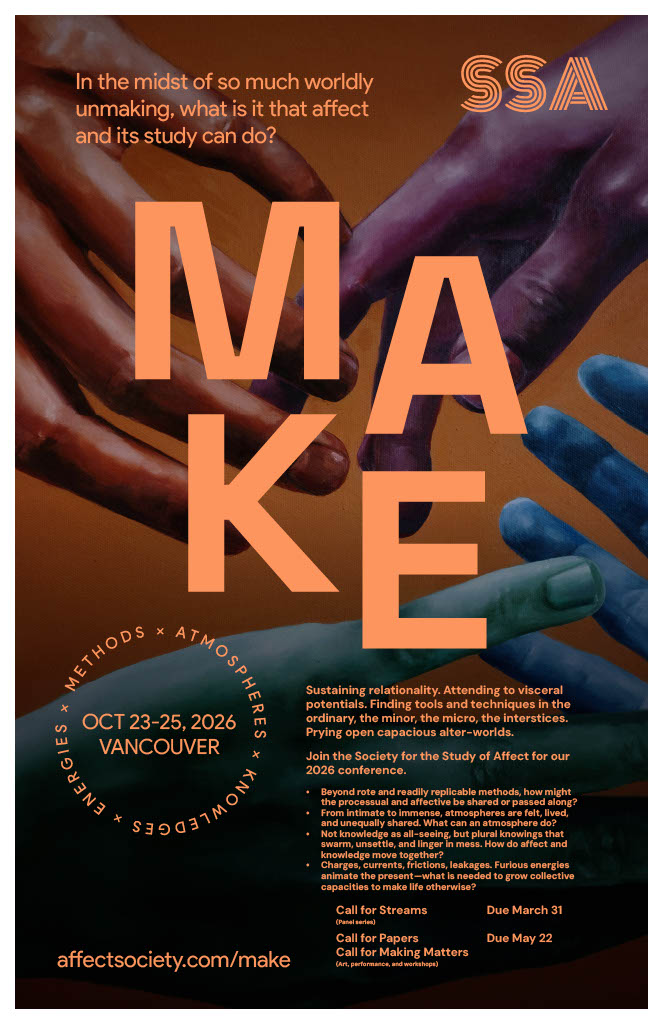
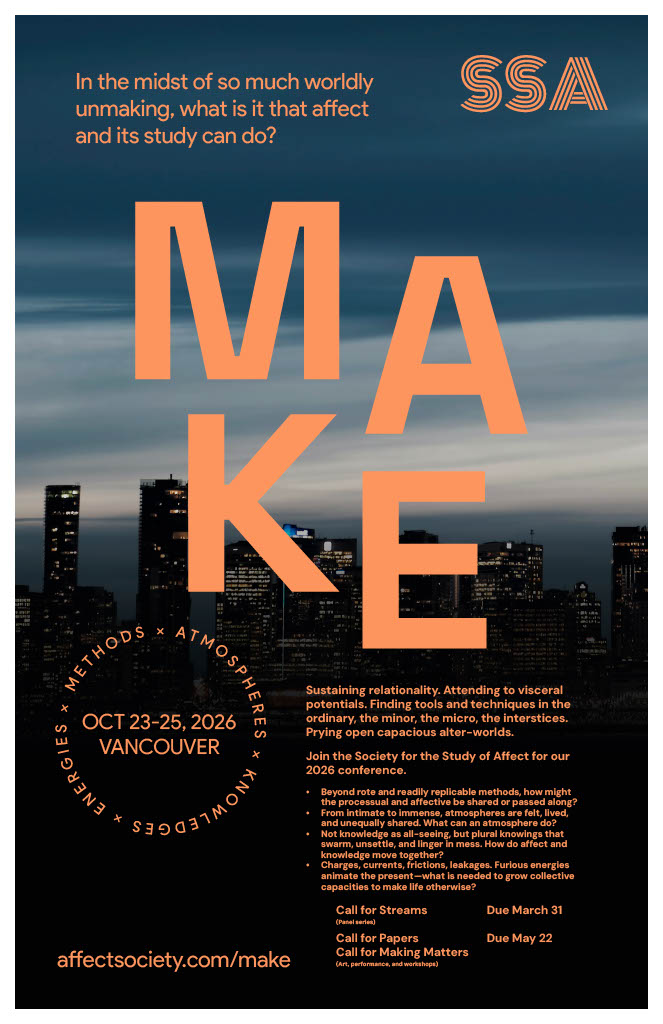
In the midst of so much worldly unmaking, what is it that affect and its study can do?
- To MAKE a substantial difference to how ongoing modes of relationality are fostered and sustained,
- To create or contribute to visceral potentials-in-the-MAKING for more (to) life while also interrupting the relentless drives of sadness, terror, and death,
- To look within the everyday, the ordinary, the minor, the micro-, the outside, the margins, and the interstices for tools and techniques being MADE that can pry open capacious alter-worlds and glimpses of hope against hope for today
Core Committee
Mathew Arthur
Capilano UniversityGregory J. Seigworth
Millersville UniversityEldritch Priest
Simon Fraser UniversityWendy J. Truran
Northeastern UniversityAnn Cvetkovich
University of Texas Austin
Conference
Themes
MMethods
Affect theory is rather notoriously non-receptive—if not downright resistant or hostile—to the spelling out of its methods (too) prescriptively or procedurally. Still, there are various ways of parsing and prompting process that affect studies/affect theory undertakes in its MAKING that can be helpfully illustrative and generative for (extra-/trans-) disciplinary conversations and progressive political aims that desire to move beyond the rote and readily replicable. So, how should affect theory approach the question of methods but, more so, how should such 'processual and affective' methods be shared, communicated, passed along?
AAtmospheres
This is where so much affect theory dwells! Atmospheres from intimate (often interiorized) to immense (world climate), ranging from unacknowledged or barely perceptible to so damned heavy that you work to maneuver its shifting or find a means of escape. Never just a metaphor, an atmosphere is felt, real, lived, shared (if often unequally), contaminating/contaminated (for good and for bad), a density/dispersity in perpetual oscillation, etc. The very minute you ask about 'capacities to affect or be affected,' you also enter into the matter of atmospheres and atmospherics. 'What can an atmosphere do?' sidles up to 'what can a body do?'—a mutually-imbricated ongoingness that never closes. How do atmospheres figure into your work?
KKnowledges
Perhaps it happens almost inevitably when 'knowledge' is spelled with a capital 'K.' Knowledge = Western. Enlightenment. Rationality. Measure and measured. Instrumentalized. White. Normative. Subtractive of feeling. Eliminative of affect. But knowledges (with an 's') adds the necessary pluralization of a knowing-otherwise excess that swarms and unsettles Knowledge as transcendent and all-seeing. Hence, knowledges that embrace the mess, the curiosity, the wonder, and the reality of experiment and experience: indigenous, esoteric, black, brown, eastern, aesthetic, ecologic, etc. What can reason do (intertwined with affect, with a body, with an atmosphere) when it recognizes its emplacement, its singularity, the capacities and incapacities of its own truth-affects? What's the doing of knowledge in affect theory?
EEnergies
Energies course through affect studies as diffuse and material forces. Intimate and infrastructural, they register as charges, currents, frictions, accretions, and leakages that move through (and across) bodies, ecologies, and technologies. In the 1986 Public Image Ltd song 'Rise' John Lydon (Johnny Rotten) repeats over and over again 'anger is an energy.' He admits 'I could be wrong. I could be right.' Forty years later, in 2026, we know he's always been right. While affect studies maintains that emotion and affect are not synonyms, when it comes to the feeling-passage of the energies of a body and between bodies, anger is a common currency in the contemporary economy of affect. Rise/fall. Escalating, de-escalating, modulating. There are furious energies (anger, yes but not only) in circulation right now that foreground affect studies—with its attunements to the passage of intensities—as something more than another interpretive practice but also a transactor of energy conversions that directly confronts the rising fascisms of our age. What energies are needed to grow collective capacities to make life otherwise?



Call for
Papers
Due May 29, 2026
The #MAKE 2026 call for papers is open! Browse the streams below and submit your 250-word abstract to the one that best fits your paper. Together, these streams gather up a rangy set of methods, atmospheres, knowledges, and energies—making space for unexpected crossings, vibes, and capacities to make life otherwise.
Streams PDF
The final deadline for proposed paper abstracts to be submitted to a specific stream will be Friday, May 29, 2026. Acceptance will be communicated within one week of the deadline for submissions (June 5).
Paper submissions are now open.
SUBMIT A PAPER
Making
Matters
Due May 29, 2026
For those who pursue affect in ways that might be somewhat less formally academic and more aesthetic/performative/poetic/evocative, etc, we welcome the submission of proposals for performances, art installations, musical pieces, film and video showings, and similarly provocative interventions.
Please submit a detailed description of no more than 500 words regarding any such activity (including special requirements for space and some sense of the time-range) by no later than Friday, May 29, 2026.
Initial inquiries about the possible inclusion of such work at this conference are encouraged well before the deadline.
SUBMIT TO MAKING MATTERS
The composition of panels will be finalized by mid-June. The conference's program, including any and all performance-related works, will be posted by early July.
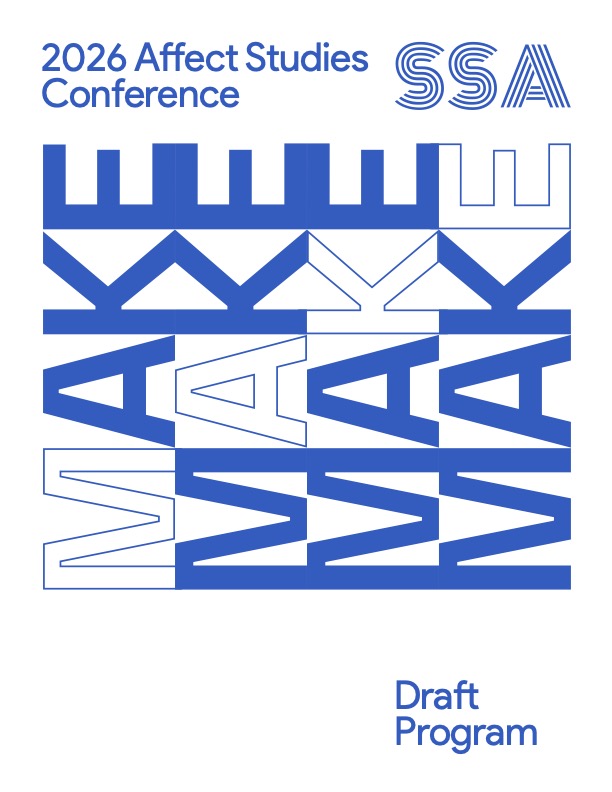 Download the draft conference program and schedule (PDF)
Program

Important
Dates
Registration
Registration for the conference will begin in Mid-June. After September 15, the registration for each category increases by $65 CAD ($46 USD).
Registration includes admittance to all conference events, daily coffee and tea service with pastries and fruit and one conference lunch. The conference dinner is optional at $40. You must be a member of the Society for the Study of Affect to register.
A small number of fee waivers are available for those facing financial barriers to attending. Please contact hello@affectsociety.com by June 30, 2026 for application instructions.
Dinner
and Cocktails
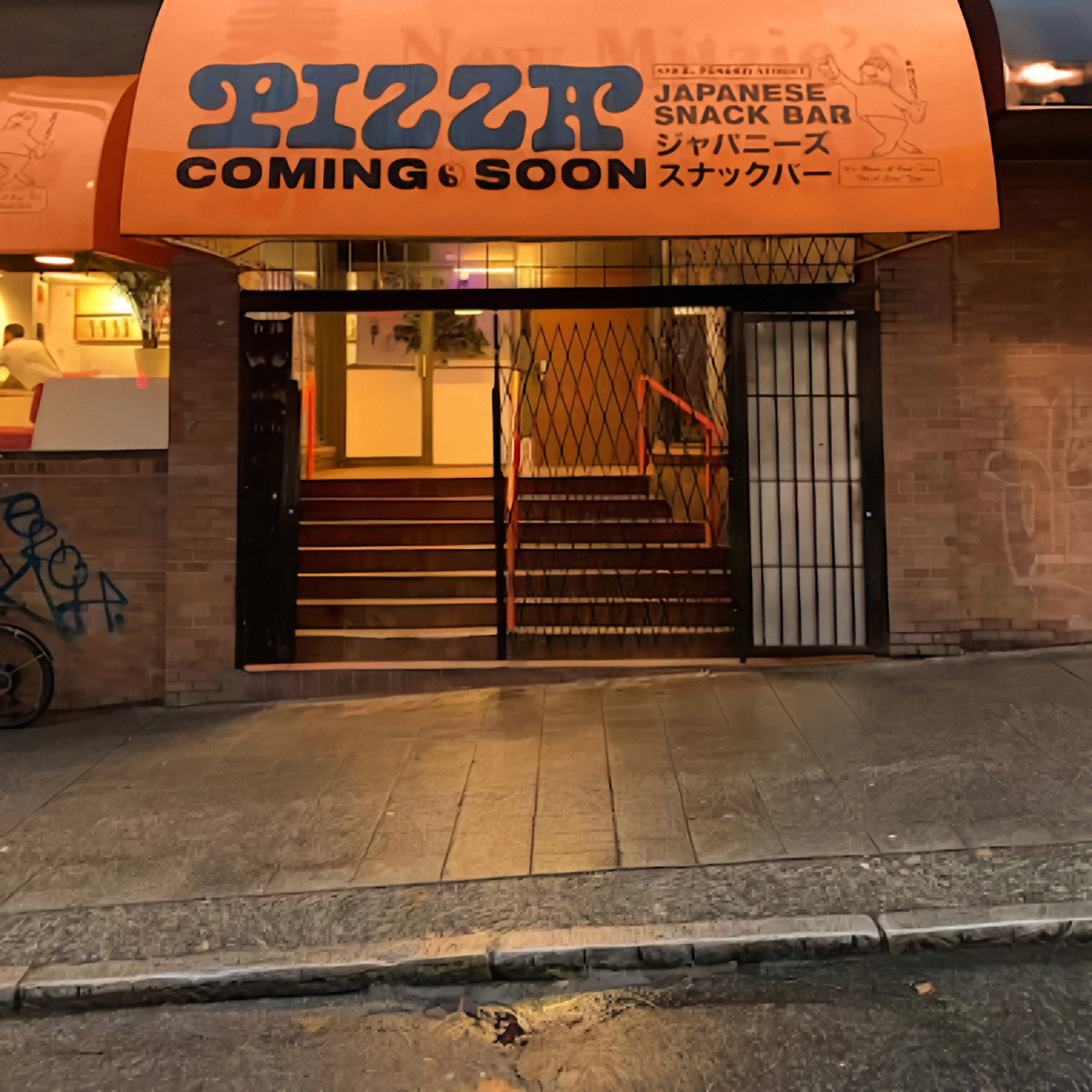
We’ll wrap up with a closing party at Pizza Coming Soon, a former Chinatown diner turned quirky izakaya. Dinner will include a buffet dinner, drink tickets for cocktails, and a cash bar. Tickets are available with registration (limited to 100).$40 CAD ($28 USD)
179 Pender Street East
SEE SAMPLE MENU
Getting Here
Simon Fraser University, Vancouver Campus
149, 515, and 580 West Hastings Street
Located in downtown Vancouver, the SFU Vancouver campus is easily accessible by public transit, car, and from Vancouver International Airport (YVR). The conference will be held at the SFU School for Contemporary Arts, Harbour Centre, and the Wosk Centre for Dialogue. Venue map and travel details coming soon.
The campus is a 5-minute walk from Waterfront Station, which connects to the SkyTrain Canada Line from the airport, as well as the Expo and Millennium Lines.
Limited paid parking is available nearby. We recommend using public transit when possible.
We have secured discounted rates at the following hotels:
Sandman Signature Vancouver Downtown Hotel
180 W Georgia Street, Vancouver
$159 CAD/night
(plus 20% tax)
Less than 10-minute walk to venue
Hotel Willo
733 Beatty Street, Vancouver
Formerly YWCA Hotel Vancouver, Hotel Willo is a comfortable social enterprise hotel with private rooms, multiple bathroom options, guest kitchens, air conditioning, mini-fridges, TVs, and wireless internet. Revenue supports YWCA BC community programs.
604-895-5842
$108–$224 CAD/night
(plus 20% tax)
10-minute walk to venue
Century Plaza Hotel
1015 Burrard Street, Vancouver
$209 CAD/night
(plus 20% tax)
25-minute walk to venue